
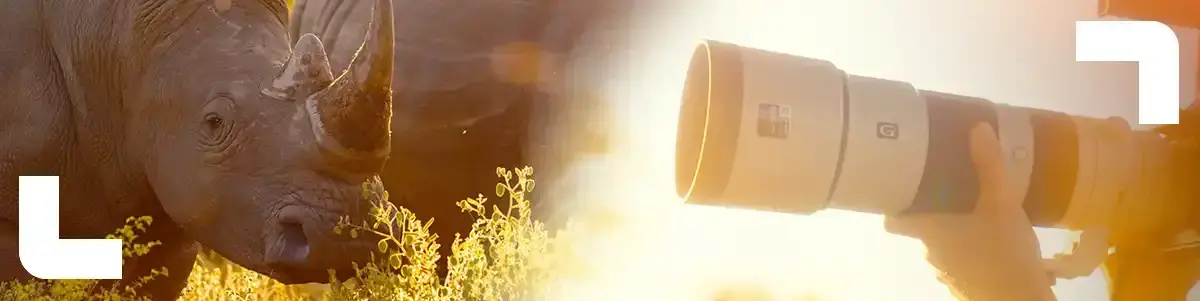
A safari is arguably the ultimate test for your gear. The animals won't come to you, the light changes constantly, and the decisive moment often lasts just a second. With the right telephoto lens, you make the difference between a "nice snapshot" and that one sharp shot you'll still be proud of years later.
In this blog we run through three telephoto lenses that take your safari to the next level, for Sony, Canon and Nikon. We finish with a camera body that pairs perfectly with them. The beauty of it: whether you want to capture wildlife up close or far away, there's an ideal match for every system.
What to look for in a safari lens
Before we dive into the lenses, let's cover the basics. On safari it comes down to a few things:
Reach matters because you often can't get close to the animals. The more mm, the more you pull the subject toward you. Fast and reliable autofocus is crucial, because a sprinting cheetah or a bird taking flight won't wait for your camera. Image stabilisation helps you get sharp shots from a bumpy jeep or handheld. And finally, weather resistance: dust, heat and the occasional rain shower simply come with the territory.
With those points in mind, here are the three lenses.
1. Sony FE 100-400mm f/4.5 GM OSS — the all-round reach
If you shoot Sony and can only bring one lens, this is a top contender. The 100-400mm range is exactly what you want on safari: enough to frame a herd of elephants at 100mm, and enough reach to pull a leopard in a tree into focus at 400mm.
What makes this lens great on safari:
- The XD Linear Motor autofocus system is lightning-fast and virtually silent, ideal for tracking fast-moving animals.
- The built-in Optical SteadyShot image stabilisation keeps your images sharp at longer focal lengths, even handheld or from a moving jeep.
- The weather-sealed G Master construction in magnesium alloy can handle dust and changing conditions.
- At 1840 g, it stays manageable for a lens with this kind of range.
When it works well:
- Wildlife at varying distances
- Birds and fast action
- When flexibility is your top priority
Tip: this lens also works great with a teleconverter when you want even more reach. Handy for the truly shy animals.
2. Canon RF 70-200mm f/2.8L IS USM Z — the bright all-rounder
Shooting Canon RF? Then the RF 70-200mm f/2.8L IS USM Z is a beautiful choice. The range is a little shorter than the Sony, but you get something lovely in return: a constant f/2.8 aperture across the entire zoom range.
That f/2.8 is worth its weight in gold during the golden hours early in the morning and late in the afternoon, exactly when animals are most active and the light is at its most beautiful (but weakest). On top of that, the large aperture delivers gorgeous subject separation, so your subject really stands out from the bush.
Why this lens shines on safari:
- Constant f/2.8 for low light and beautiful bokeh.
- Compatible with the RF 1.4x and RF 2x extender, so you can stretch the reach to 280mm or even 400mm whenever you need it.
- The internal zoom mechanism keeps the balance stable, great for handheld work and video.
- At 1110 g, this is a surprisingly compact and lightweight 70-200mm.
When it works well:
- Early-morning and evening safaris in low light
- Portraits of animals with a creamy background
- When your subjects are a bit closer (waterhole, hide)
3. Nikon Z 70-200mm f/2.8 VR S II — control at your fingertips
Nikon shooters are well served by the Z 70-200mm f/2.8 VR S II. Like the Canon, it has a constant f/2.8, but Nikon puts the emphasis on handling and optical perfection.
The Vibration Reduction stabilisation of up to 6 stops is impressive and means you can get sharp handheld images even at slower shutter speeds. Useful when the sun is setting and you still want that sharp shot. On top of that, you get two programmable L-Fn buttons, a focus limiter switch and a control ring, so you can adjust settings without taking your eye off the viewfinder, crucial when something suddenly happens.
What makes this lens strong on safari:
- VR up to 6 stops for maximum sharpness handheld.
- The Silky Swift VCM autofocus system is fast, quiet and precise, perfect for reportage and wildlife work.
- Advanced optics with Super ED, ED, fluorite and SR elements plus Meso Amorphous & ARNEO coatings to fight flare in backlight (think of a rising sun behind your subject).
- The 11-blade diaphragm delivers soft, natural bokeh.
When it works well:
- Backlit situations (sunrise/sunset)
- When you want plenty of control over your settings
- Reportage-style wildlife where switching quickly matters
And the body? The Sony A7R VI
A good lens deserves a body that can keep up. The Sony A7R VI is an excellent example of that, especially in combination with the Sony 100-400mm above.
What makes the A7R VI so suited to safari:
- The 66.8 MP stacked Exmor RS sensor gives you an enormous amount of detail. That means you can crop heavily without losing quality, ideal when an animal is just too far away for your 400mm.
- The AI-driven autofocus system automatically recognises and tracks people, animals and birds. On safari, animal detection is pure luxury: you aim, and the camera finds the eye.
- Up to 30 fps blackout-free continuous shooting means you capture the entire sequence of a fleeting moment and pick the perfect frame.
- The 5-axis SteadyShot stabilisation of up to 8.5 stops complements your lens's stabilisation, double insurance from a moving vehicle.
- A magnesium body with weather sealing that can handle the conditions, and two card slots so you never run out of storage on the day it matters.
In short: lots of resolution, smart autofocus and the speed to seize the decisive moment. Exactly what you need on safari.
Summary
For safari, the rule is: reach, fast autofocus and stabilisation are your best friends. If you want maximum flexibility and reach, the Sony FE 100-400mm f/4.5 GM OSS is a fantastic all-rounder. If you're on Canon or Nikon and value brightness for the golden hours, the Canon RF 70-200mm f/2.8L IS USM Z and the Nikon Z 70-200mm f/2.8 VR S II both offer a beautiful f/2.8 with the option to grab more reach via an extender.
Combine that with a fast, high-resolution body like the Sony A7R VI and you're all set to bring that dream shot of the big five back home.